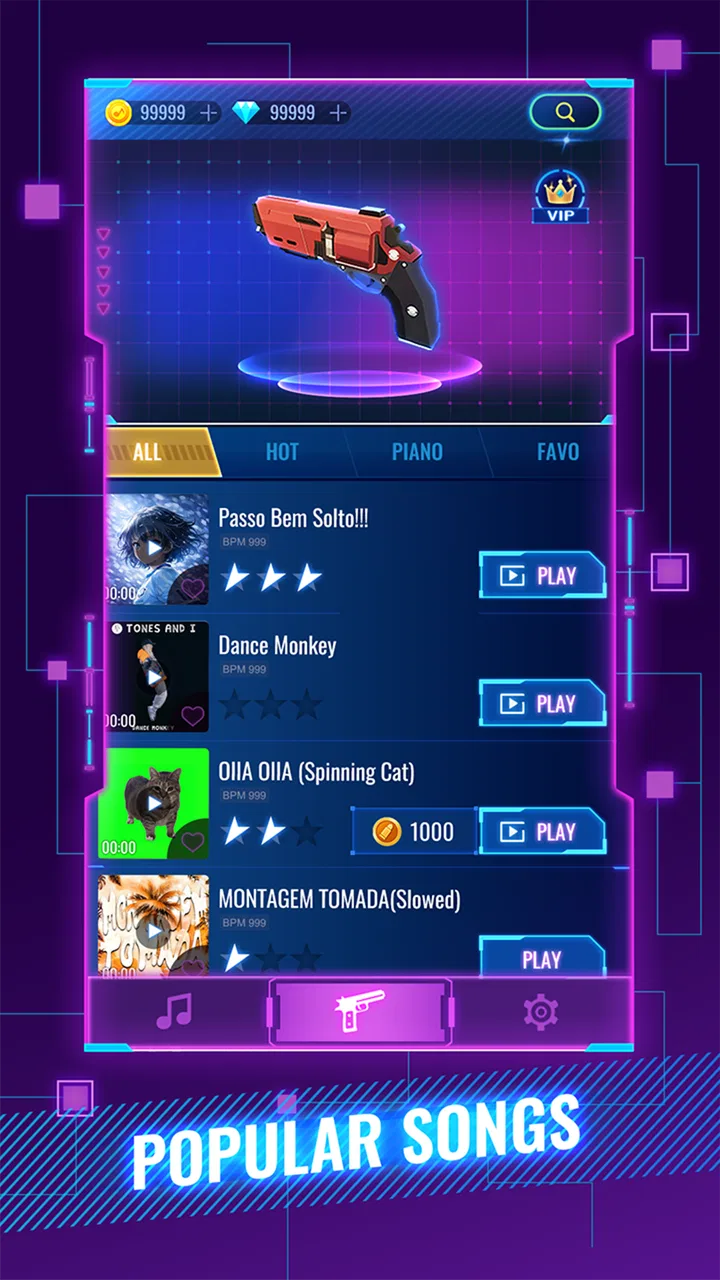
Rhythm Fire-EDM Shooting Game
- 4.7
- Rating
- 10.00M
- Installs
- Free
- Price
 Analysis by App-foxy
I approached Rhythm Fire-EDM Shooting Game expecting a simple music game with a shooting theme, but its central idea is more interesting than that description suggests. The important capability is the way it asks me to line up shooting actions with the rhythm of electronic music. My attention is divided between timing, aiming, and reacting to what appears on screen, so the experience feels closer to a short coordination workout than to a passive music player or a conventional target game.
That focus gives the game a clear identity. I am not simply listening to a track while tapping randomly, and I am not playing a standard shooter where music sits in the background. The soundtrack becomes the guide for my actions, while the gunplay gives each beat a physical response. When the timing clicks, the result is satisfying because my eyes, ears, and hands seem to agree for a moment. When I lose the rhythm, even a familiar pattern can suddenly feel messy.
Adaric Music presents it as a free music game for players who want quick, energetic sessions. It is rated for Everyone 10+, runs on Android versions from 6.0 onward, and its current version is 1.006. The game has already passed the five-million-install mark and holds a 4.8 average from roughly five thousand ratings, which suggests that its straightforward rhythm-and-aim concept has found a substantial audience. I still think the real question is not whether it is popular, but whether this particular combination suits the way you like to play.
You May Also Like

 Blood Strike: 2.5 Anniversary
Blood Strike’s Loadouts Turn Every Drop Into a Tactical Gamble
A close look at Blood Strike’s custom loadouts: how fast access to signature weapons reshapes its battle royale rhythm, rewards preparation, and narrows the gap between fights.

 Pandora - Music & Podcasts
Pandora’s Music Is Easy to Start, but Harder to Recover
Pandora’s strength is its low-effort path from a seed to a station. Its weak spot is how much confidence it asks you to place in connection, setup, and quiet recovery.

 8 Ball Pool
 Is Built on Rivalries, Rematches, and Routine
A close look at the rivalries, rematches, shared routines, and unanswered safety questions that turn a quick pool match into a persistent mobile community.

 Samsung Music
’s Quiet Strength Is Playing What You Already Own
Its reach comes less from spectacle than from dependable access to a personal library. That simplicity is both the app’s strongest retention engine and its ceiling.

 AccuWeather: Weather Radar
AccuWeather Review: A Quick, Clear Forecast for Everyday Decisions
For everyday plans, the best forecast is the one you can understand quickly. AccuWeather makes rain timing, radar, and local conditions easy to act on, with a few trade-offs.

 Hill Climb Racing
Why Hill Climb Racing Still Turns Crashes Into One More Run
A tiny car, a bumpy hill and one more upgrade: Hill Climb Racing keeps resurfacing because its simple chaos makes every near-miss feel personal.
More From Our News Desk



Why rhythm-based shooting is the whole experience
The strongest part of the game is also the part that determines whether you will enjoy it. The shooting is meaningful because it is tied to musical timing. Instead of treating each target as an isolated object, I naturally start listening for the pulse and anticipating the next action. That changes the mood from “hit everything quickly” to “stay in sync while staying accurate.” It is a small distinction, but it makes the game feel more musical than an ordinary aim trainer.
In practice, this capability rewards controlled attention rather than frantic tapping. I found that rushing usually works against the music. A player may see a target and react immediately, but the better response is often to recognize where the beat is going and move with it. That makes the game approachable at first, yet it leaves room for improvement because consistency is harder than simply understanding the controls.
The EDM direction is a natural match for this design. Electronic music tends to provide a strong, regular pulse, so it gives my actions a clear sense of momentum. The result is more physical than playing a melody-based puzzle, but less demanding than a full competitive shooter. The game sits in a useful middle ground: I can enjoy the sound and visual energy without needing the long-term commitment that a larger action game often demands.
The key benefit is immediate feedback: my timing is not an abstract score hidden behind menus. I feel a difference when I fire with the beat, and I notice when my attention slips. That makes even a short session feel purposeful. I can play for a few minutes to reset my concentration, or stay longer when I want to improve my control.
What a typical session feels like
When I start a session, I try not to treat the first moments as a race. I listen for the track’s pulse, watch how the targets arrive, and then settle into a repeatable movement. This is more effective than trying to dominate the screen immediately. Once I find the rhythm, aiming becomes less about isolated reactions and more about maintaining a pattern.
That pattern can break for several reasons. A sudden visual change, a missed shot, or a moment of hesitation can pull my attention away from the music. Recovering is part of the challenge. I have to decide whether to chase the next action or wait for the rhythm to become clear again. That decision gives the game more texture than a simple sequence of taps, even though the basic premise remains easy to understand.
I also appreciate that the concept is readable without a long explanation. Someone watching over my shoulder can understand the goal quickly: follow the music and shoot accurately. This makes it a reasonable choice for casual play, especially when I want something more active than a standard music app but less involved than a story-driven game.
How to improve without turning it into homework
My most useful adjustment was to focus on timing before speed. If I tried to move as quickly as possible, I created more mistakes and lost the musical flow. Slowing down slightly helped me recognize the beat and made accurate shots feel repeatable. This is a practical tip for new players because the game’s energy can encourage overreaction.
Another useful habit is to play with a consistent grip and avoid changing how I hold the device during a track. Small changes in hand position can affect where I aim, especially when I am already trying to listen and watch at the same time. Keeping my hands relaxed also helps; tension makes every correction feel larger than it needs to be.
I would also use the game as a short focus exercise rather than assuming every session needs to be a high-score attempt. A few deliberate rounds can reveal whether my problem is timing, visual tracking, or simply impatience. That distinction matters. If I keep missing because I act early, I need to listen more carefully. If I miss after losing sight of the target, I need to give the screen more attention. Treating mistakes as information makes the game more rewarding.
Where the capability works best in everyday play
The best scenario for me is a short break when I want to wake up mentally without starting a large game. Imagine having ten minutes between tasks: I can launch the game, put my attention on the beat, and play actively instead of scrolling through another feed. The session has a clear beginning and end, and the combination of music and aiming gives my hands something precise to do.
It also suits players who enjoy rhythm games but want more direct interaction than tapping notes in a lane. The shooting action adds a sense of direction and reaction. Conversely, people who prefer shooters may find it a gentler way to practice visual timing, although it should not be mistaken for a replacement for a competitive aiming game. The musical structure changes the priorities, so accuracy alone is not the entire point.
I can see it working well for casual gatherings too. The rules are easy to explain, and the music makes the game immediately understandable to someone who has not played it before. The main limitation in that setting is that enjoyment depends on the listener’s response to EDM-style energy. If someone dislikes that sound, the central appeal may not survive the first session.
For younger players, the Everyone 10+ rating is worth taking seriously as a basic suitability guide. I would still make the decision based on the individual child, especially because the game combines fast visual movement, music, and shooting imagery. It is not a realistic military simulation in the way a conventional shooter might be, but parents should choose games according to the player’s sensitivity and comfort rather than relying on the label alone.
Who should choose it over a usual music game?
I would point a friend toward this game if they like music games but become bored by repeating the same tap pattern. The aiming element gives the hands a different job, and the need to react to rhythm creates a more active loop. It is especially appealing to someone who wants a game that can be understood quickly but still rewards better coordination after repeated sessions.
A traditional rhythm game may be the better choice for a player who wants deep note patterns, musical variety, or a purer focus on timing. A standard aim trainer may be preferable for someone who wants to measure precision without music influencing the pace. Rhythm Fire sits between those options, and that compromise is both its strength and its boundary.
I would not choose it as my main game when I want a long narrative, character development, exploration, or a broad progression system. Its appeal comes from the immediate loop of listening, aiming, and firing. If that loop does not feel satisfying within the first few sessions, there is no reason to force it simply because the rating is strong.
Trade-offs that become clearer after playing
The free entry point is welcome, especially for a game built around quick experimentation. I can try the central mechanic without committing money first. However, the presence of in-app purchases ranging from $7.99 to $49.99 per item means I would approach the store carefully. The free price makes testing easy, but anyone who dislikes optional spending prompts should decide in advance whether they are willing to ignore purchases or set a firm budget.
That financial trade-off is more important here because the basic concept is easy to understand quickly. I would not spend immediately just to discover whether I like rhythm shooting. I would first play enough to learn whether the music, aiming, and visual pace work for me. If the core loop already feels repetitive, paid content is unlikely to fix that personal mismatch.
There is also a concentration trade-off. The game can feel energizing when I am alert, but it is not ideal when I want a relaxing background activity. I cannot enjoy it fully while watching another video or holding a conversation because the musical timing and aiming require active attention. That is a strength for focused play, but a weakness for multitasking.
Another limitation is the narrowness of its identity. The same feature that makes it memorable can make it less flexible than a broader music game. If I want a quiet song, a slower puzzle, or a completely different genre, this is not the app I would open. Its value depends on wanting this specific blend of electronic rhythm and shooting response.
Device compatibility is reasonably broad because it supports Android from version 6.0 onward, but that does not guarantee that every older phone will feel equally comfortable. Rhythm games are sensitive to touch response, screen visibility, and audio timing. On an aging device, I would pay attention to whether controls feel immediate and whether the sound remains easy to follow. If the experience feels delayed, the problem becomes especially noticeable because timing is the game’s foundation.
Questions I would answer before recommending it
Is it suitable for a complete beginner? Yes, if the player is comfortable learning through repetition. The basic idea is simple, and I do not need specialist knowledge of music or shooting games. The challenge comes from becoming consistent, not from understanding complicated rules.
Can it replace a serious shooter? No. I would recommend it for rhythm-focused coordination and short sessions, not for tactical depth, realistic competition, or advanced weapon handling. Someone seeking those things should choose a dedicated action game instead.
Is it useful without spending money? The game is free to start, so I can evaluate the main experience before considering purchases. I would keep expectations practical, though: players who want every possible extra may eventually face the temptation of the paid items, and the listed range makes a cautious approach sensible.
Does it work as a music discovery tool? I would not use it primarily for that purpose. The music supports the gameplay, and my attention is directed toward timing and aiming rather than exploring songs in a relaxed way. It is better understood as an interactive rhythm game than as a replacement for a streaming service.
Is it a good choice for long sessions? It can be, but I think it is strongest in focused bursts. Repetition may feel satisfying while I am improving, yet the narrow loop can become tiring if I expect the variety of a large all-purpose game. Taking breaks helps preserve the sense of timing instead of turning every track into a mechanical routine.
My recommendation for the right kind of player
After spending time with it, I see the game’s real appeal in the connection between sound and action. The shooting is not just decoration, and the music is not merely background noise. Each side changes how I approach the other. I listen more carefully because I need the beat, and I aim more deliberately because a mistimed action breaks the flow.
That makes it a strong recommendation for players who want a compact, energetic music game with a physical control challenge. It is also a good option for someone looking for a quick mental reset, provided they enjoy electronic music and do not need a complex progression system. The large install base and high average rating make it easy to see why the concept attracts attention, but personal taste still matters more than popularity here.
I would skip it if I dislike rhythm-based repetition, want a calm audio experience, or expect a full shooter with tactical depth. I would also be cautious about purchases until I knew the free experience genuinely held my attention. Those are not minor details; they define whether the game feels focused or limited.
For me, the deciding strength is how clearly every successful action communicates timing. I do not need a long tutorial or an elaborate story to understand what I am improving. I simply try to hear the pulse, keep my aim controlled, and stay with the track. If that focused loop sounds more appealing than a conventional shooter or a standard tap rhythm game, this free release from Adaric Music is worth trying.
Released on August 26, 2025, it is still a focused recommendation rather than an all-purpose game. Its 4.8 average across about five thousand ratings and more than five million installs show strong interest, while the 38 written reviews offer a smaller amount of detailed public discussion. I would judge it by a few personal sessions instead of by numbers alone. If the beat makes your aim feel more natural, Rhythm Fire can turn a short break into a surprisingly engaging coordination challenge.
FAQs for Rhythm Fire-EDM Shooting Game
01What are the main features of Rhythm Fire-EDM Shooting Game?
Rhythm Fire-EDM Shooting Game combines pulsating EDM tracks with engaging shooting mechanics, creating a unique rhythm-based gameplay experience. Players navigate through vibrant environments, shooting targets in sync with the beat. The game offers multiple levels, each with increasing difficulty, and a variety of tracks to keep players entertained.
02Is Rhythm Fire-EDM Shooting Game free to play?
Yes, Rhythm Fire-EDM Shooting Game is free to download and play. However, it may contain in-app purchases for additional content, such as exclusive tracks, power-ups, or cosmetic items. These purchases enhance the gaming experience but are not necessary to enjoy the core gameplay.
03What devices are compatible with Rhythm Fire-EDM Shooting Game?
Rhythm Fire-EDM Shooting Game is available for both Android and iOS devices. It is optimized for smartphones and tablets, requiring a stable operating system to ensure smooth gameplay. Make sure your device meets the minimum system requirements, which are typically listed on the app’s download page.
04Does Rhythm Fire-EDM Shooting Game require an internet connection?
While Rhythm Fire-EDM Shooting Game can be played offline, some features like multiplayer modes or leaderboard updates may require an internet connection. Playing online allows you to compete with friends or global players and access the latest updates and content releases.
05Is Rhythm Fire-EDM Shooting Game suitable for all ages?
Rhythm Fire-EDM Shooting Game is generally suitable for players of all ages, but it’s always a good idea for parents to check the content for age-appropriateness. The game features bright visuals and EDM music, which are appealing to a broad audience, but the shooting mechanics may not be suitable for very young children.
Pros
- Engaging EDM soundtrack enhances gameplay.
- Intuitive controls make it easy to learn.
- Vibrant graphics create an immersive experience.
- Regular updates with new levels and music.
- Offline mode available for on-the-go play.
Cons
- In-app purchases can become pricey.
- Ads may interrupt gameplay frequently.
- Limited customization of characters.
- Requires a stable internet for updates.
- Battery consumption is relatively high.

Rhythm Fire-EDM Shooting Game
Gallery